
Why Deciem made a documentary
"Even while Brandon was at his lowest, the team’s belief in the vision never wavered."
Good afternoon everyone. Today’s newsletter includes a conversation with the director behind The Abnormal Beauty Company, what Europeans say we get wrong about sauna culture, and how a former Paramount executive could help the CBC’s struggling streaming business.
Regardless of what your life looked like in 2016, there’s a strong chance you were using skincare from The Ordinary. By the end of that year, the new brand from Deciem was a knockout—selling ingredient-first formulations that actually worked—for a fraction of the price of its competitors. By all accounts, it was an overnight success. In 2017, the brand was picked up by Sephora as the waitlist for new products topped 25,000 people, and Deciem had taken on investment from Estée Lauder, an influential beauty conglomerate.
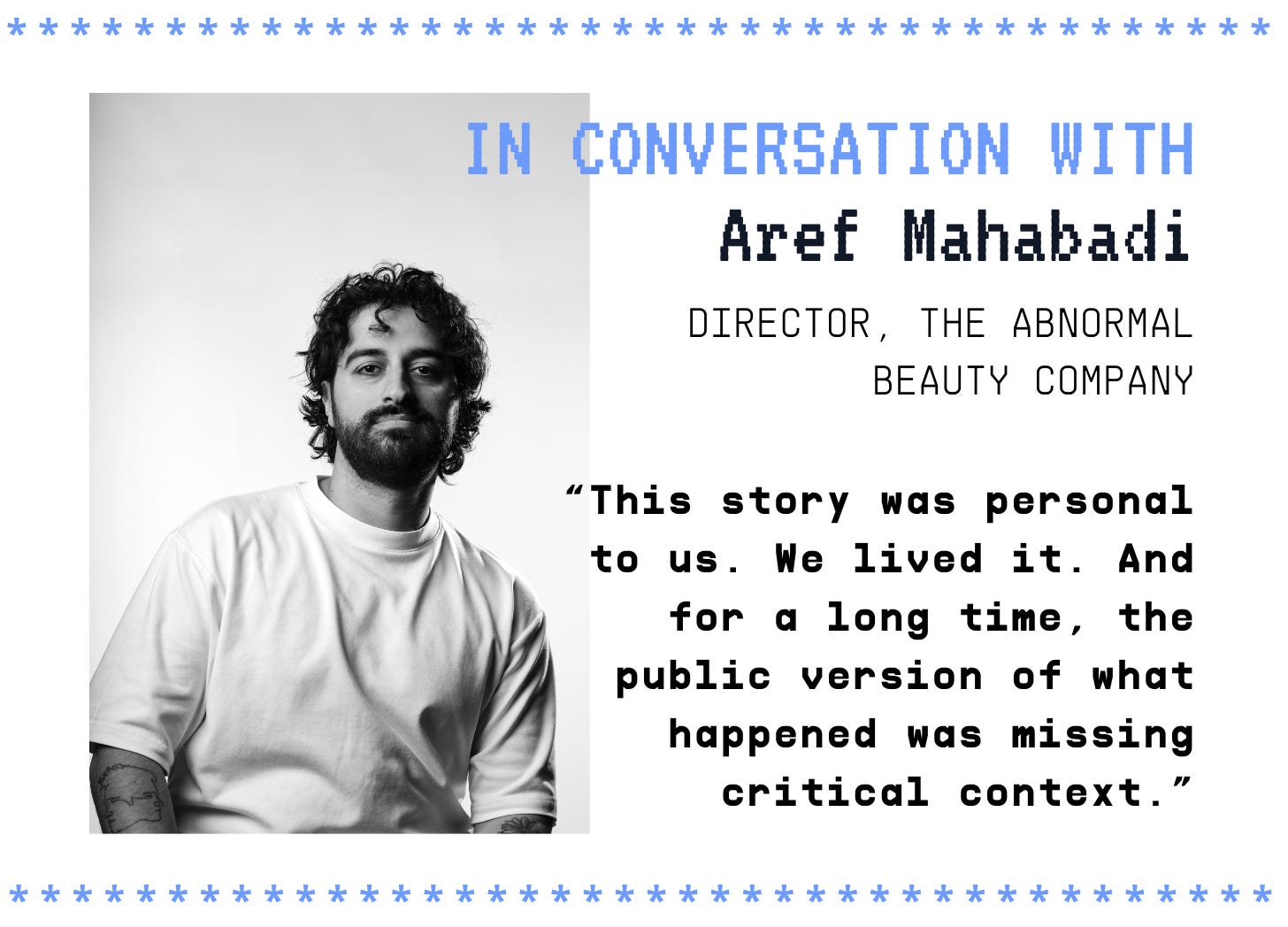
Deciem’s late founder, Brandon Truaxe, fundamentally changed how we think about and buy skincare. Yet when many of us think of the company, our minds go to his very public unraveling and the tragic death that followed. That’s why the people who knew Brandon best—his coworkers—have spent the last five years creating a film that tells a more complete version of the story. Ahead of today’s release on Crave, I caught up with the award-winning director Aref Mahabadi about what went into making this documentary.
Why decide to tell this story? And why tell it now?
This story was personal to us. We lived it. And for a long time, the public version of what happened was missing critical context, context that only the people inside the company truly had. We felt a responsibility to tell the story as we experienced it. For years, there was an understandable instinct for us to stay quiet, to move on, to avoid reopening something painful. But we slowly realized that avoiding discussing our experience only flattened the narrative and left too many people feeling unseen or misunderstood.
How did ‘living it’ impact your storytelling?
I joke to my friends that even the archival B-roll was shot by me. Having been there in 2016, I knew the genius Brandon was capable of, the way he could see a gap in the market and fill it with pure innovation. I realized early on in the filmmaking process that focusing solely on the ‘genius’ or the ‘crisis’ was a trap, it’s what everyone else would do. To me, the most responsible and creatively honest way to tell this story was through our shared personal experiences that no other filmmaker would have access to.
What went into putting together the film?
We spent nearly five years discussing not just how to tell this story, but when. When you’re dealing with a legacy as complex as Brandon’s, you don’t rush. We needed time to process the grief and the chaos so we could move past the sensationalism and get to the soul of the story. The moment we aligned on the vision, that this had to be an intimate, deeply personal film from the perspective of those who lived it—everything clicked. From that day on, we never looked back. We spent years traveling the world, seeking out the people who actually sat in the rooms with him, from close family to childhood friends. It was a global search for the people who knew him across different chapters of his life and an incredible experience for myself as someone who was able to get to know Brandon on a deeper level.
What do you think was missing from the headlines?
There was a deeply human story unfolding in real time. One that included friendships, loyalty, disagreements, humour, exhaustion, care, and genuine belief in something new. The coverage often flattened Brandon into a single narrative, but the people who knew him speak to his curiosity, generosity, brilliance, and the sheer scale of what he wanted to build.
What can people learn from Brandon as a founder?
Brandon didn’t just take creative risks; he took reputational risks. He was a founder who spoke with unusual conviction and stood firmly behind what he believed, even when it challenged industry norms. He said exactly what he believed and believed exactly what he said regardless of the repercussions. He proved that in an industry built on filters, there is nothing more powerful than the truth.
What do you hope will surprise people about the film?
There is a deep honesty in these interviews that you can’t fake. You see the internal conflict of the team: the genuine excitement of being a part of something meaningful, the pride in the work they were doing in the lab, juxtaposed with the heartbreak of watching their leader struggle in very human ways. People will be surprised to see that even while Brandon was at his lowest, the team’s belief in the ‘Abnormal’ vision never wavered. Once our conversations in the interviews started to get deeper, it was clear the team weren’t staying for the paycheque; they were staying for the dream he gave them and to carry his mission forward.
Deciem has committed $2 million to CAMH to support their work in mental health and addiction.
SSENSE’s lenders are trying to block a deal that would let the founders buy back the company. That deal is supposed to close in a few weeks, but a group led by BMO argues that a liquidation would recover more cash.
A former Paramount executive has been tasked with turning around the CBC’s business. Douglas Allan Smith replaces Barbara Williams, who last I remember was pushing for the CRTC to require U.S. streamers, like Netflix, to pay into the Canadian system (an issue that’s currently playing out in court). Douglas led streaming and content licensing in Canada and may be able to help the CBC monetize CBC Gem, its streaming platform.
This summer’s World Cup matches will be some of the first to see the use of soccer balls with sensors. The Adidas-made balls first appeared in 2022 with the goal of capturing real-time data and feeding it into a video system designed to help referees make faster and more accurate calls.
The current and former Prime Ministers are in Davos this week. None of us should be surprised to see Justin Trudeau entering the international speaking circuit, but I can’t say I ever expected to see Katy Perry at Davos.
An article from The New York Times suggests that we’re getting sauna culture wrong. What’s most interesting to me is that what European sources suggest North Americans get ‘wrong’ about sauna culture—a focus on “optimization and performance” that creates a “rushed” and “almost competitive environment”—is exactly what makes it such a profitable business. More than 50 people can cram into a 90-minute guided experience at almost any point in the day for a walk-in price of $60 a head (you do the math), leaving margins so high that operators deflate them to investors, Robert Hammond , a Therme executive who also writes a Substack on bathing culture, told Bloomberg this week. I personally refuse to go back to any of these establishments until they introduce bans on smart devices, talking loudly, and pick-up lines.
Kanuk President Elisa Dahan told Fashion Network that the Québec-based outerwear brand is looking to expand in Europe. I can see it.
We were never meant to meet in virtual boardrooms. Meta is pulling the plug on workrooms in Meta Horizon, a virtual reality experience platform.
Good luck to anyone on the hook to repay pandemic benefits. The CRA is in the process of recovering $10 billion it says it’s owed, mostly by those who were found to have earned more than the $1,000-a-month threshold.
The Toronto Star has found unqualified staff working in beauty clinics across the city. Their investigation found that loose rules allow for clinics to operate, on paper, under physicians who have little involvement in the day-to-day operations, while procedures are performed by staff who may be under-qualified. A $3 million lawsuit against a clinic in Oakville argues this trend led to the death of a woman after a micro-needling procedure.


Can’t wait to watch this!